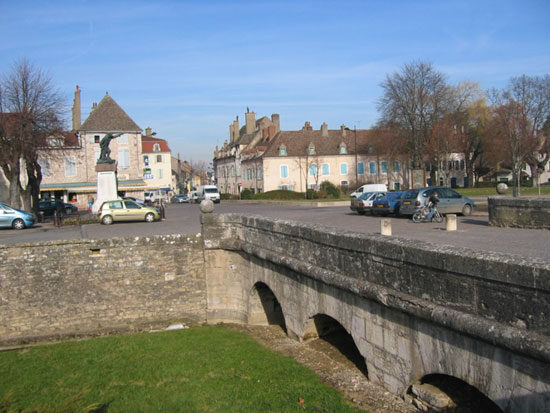
The Battle of Sennecey-le-Grand
4 September 1944 — a daring battle, conceived on two misunderstandings.
This daring battle was conceived on two misunderstandings: on the one hand, the certainty of seeing the vanguard of de Lattre's army — which had landed in Provence on 15 August — arrive at Sennecey on the morning of the 4th, when in reality it had been halted near Mâcon for lack of fuel; on the other, an enemy strength badly misjudged, which in a few hours rose from a few hundred to several thousand men flowing back towards Alsace and equipped with guns and armour.
Its plan was decided on the evening of the 3rd at the Corlay command post. It brought together most of the F.F.I. and SAS forces of the Corlay sector under the command of Captain Leduc, and was meant to lead to final victory that very day. So it did — but at what a price! Here is a summary:
The plan called for taking Sennecey from the west, south and north, in order to block and finally neutralise the German columns. Its spearhead was Guy de Combaud's SAS jeep troop which, after heavily machine-gunning the convoys parked along the main thoroughfare from south to north, was — with the help of surprise — to allow the maquisards to assault.
The set-up before the assault
On the right wing, close to the N6 and between Sennecey and Sens, the Arragon section; in the centre, between St-Julien and Ruffey, the Ballet and Janodet sections; on the left wing, between St-Julien and the Laives hill, the Desbois section reinforced by the Beaumont section and the "railwaymen" section commanded by Joubert.
West of the hill, in the Laives sector, stood the St-Gengoux maquis and the "Bretagne" company. They were to take the Laives hill, then advance along the left wing and enter Sennecey from the north-west. Simultaneously, another assault by the Tournus F.T.P. was to protect the action by cutting the N6 some 10 km further south. Unfortunately this blocking action was carried out several hours late.
The assault
At first light, the troop of 4 SAS jeeps moved from Tallant to Corlay, stopping at Jarrot's command post for final arrangements and to pick up the guide André Rivot. Then came a series of mishaps:
Near Sennecey-le-Grand, de Combaud found no maquisard lookout and therefore had no precise intelligence about the enemy ahead. Taking a turn too fast as it approached the N6, the lead jeep threw out the guide Rivot. Then the last jeep missed the turn onto the N6 near the church and hit a house; its three occupants — Tramoni, Bailleux and Baud — were wounded.
The three remaining jeeps machine-gunned all along the main street, causing enormous losses to the enemy but, having reached the northern exit of Sennecey and for an unclear reason, they delayed slipping away, turned back and came under heavy fire from an enemy that had recovered in the meantime. The jeep of Guy de Combaud, Pache, Seither and Magdeleine was stopped by a bicycle caught under its wheels, then machine-gunned. The same fate befell the 2nd jeep of Benhamou, Nectoux and the two Djian brothers. The 3rd jeep of Aubert-Stibi, Lombardo and Barkatz was destroyed by a Panzerfaust.
Meanwhile the whole "maquisards" set-up met very strong resistance in St-Julien and on the southern and south-eastern edges of Sennecey, where fierce fighting went on for several hours. On the side of the Laives hill, the men of St-Gengoux were driven back in their assault by the German detachment that dominated them from around St-Martin's church, with heavy weapons — which had not been anticipated. They fell back on Laives. Some managed to approach the N6 from the north but were also driven back. In their counter-attack the Germans shot 17 hostages in Laives, and houses were set on fire.
Another very sad event: in the afternoon a convoy of the St-Gengoux maquis was machine-gunned by American aircraft between Nanton and Vincelles; there were 7 dead.
Once the assault had been repelled, the German columns resumed their march northwards, harried by Allied fighter aircraft. The resisters were able to liberate Sennecey, followed around 5 p.m. by a troop (Lt de Bellefon) of armoured cars and half-tracks of the French 1st Armoured Division.
The toll of these battles: 850 to 1,100 killed and wounded on the German side, and 50 dead among the resisters, SAS and local population.
It may be reckoned that the sacrifice of these resisters and SAS parachutists at Sennecey helped to liberate the town of Chalon-sur-Saône the very next day.
Plan of the Battle of Sennecey-le-Grand — 4 September 1944
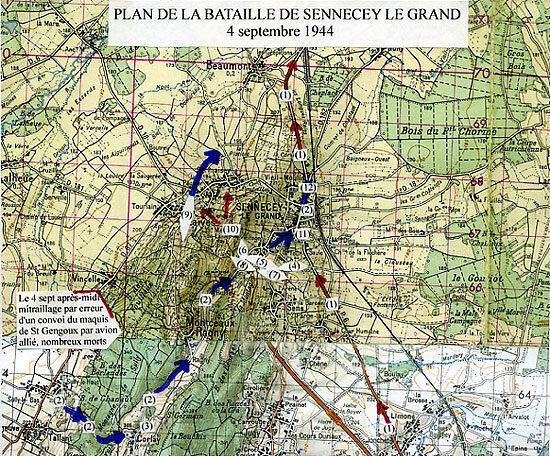
- Route of the German convoys.
- Route of Guy de Combaud's SAS jeep troop.
- Maquis command post at Corlay.
- Position assigned to the Arragon section (Mornat, Vachey, Létienne, Bourgeon, Krumenacker, Boyenval, Maurice).
- Position assigned to the Ballet and Janodet sections (André, Thibert, Baron, Lesne, Montaron, Bichard, Faudot, the Renaud brothers, Laurain, Holzman, Rostaing, Holzhauser, Papillon, Thomasset, Manuel, Bataillard, Petit, Grelin, Cretin, Kroume, Gaudillière, Ollivier, Bidaut, Balay, Jacquet, Lamé).
- Position assigned to the Desbois-Gaudillot section (Martineau, Christian, Grandjean, Jandot, Prost, Perron, Monnier, Pichery, Pigelet, Sassot).
- Position assigned to the Beaumont section.
- Position assigned to the railwaymen's section commanded by Joubert (Boursier, Trastour, Lecharpentier, Goujon).
- Position assigned to the St-Gengoux maquis, led by SAS (Boissonas, Zermati, Porot, Lacour, Dessendre, Rancier, Drillien, Montel, Laurent, Rebillard, Rabo, Régnier).
- German defence on the Laives hill and counter-attack.
- Accident of the last SAS jeep.
- Destruction of the 3 SAS jeeps.
Other participants in the battle
Ballet Jean, Berget Paul, Bonnet Paul, Laurent Georges, Cléaud Henri, Deschamp François, Guibert André, Régnier Jean, Jaurant-Singer Marcel, Leroy Guy, Mazoyet Jules, Meuriot Raymond, Montel Célestin, Morain Charles, Picque Rémy, Provenza Marcel, Rigoulot Jean, Rabo.
Sources: Le Maquis de Corlay, André Montaron, Éditions Hérode · Histoire de la Résistance en Saône-et-Loire, Patrick Veyret, éditions La Taillanderie · Paras de la France Libre, Roger Flamand · Memoirs of General Georges Lacour · Biographie des Résistants, A. Jeannet, JPM Éditions.