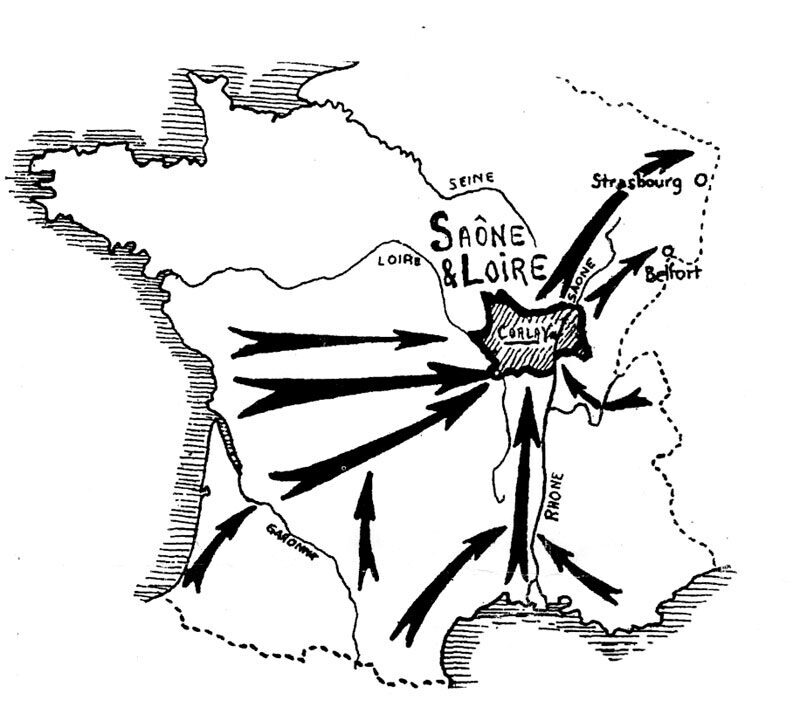
Why the Chalonnais?
Resistance and liberation of the Chalonnais during the 1939–1945 war.
Why the Chalonnais in particular?
It straddled the demarcation line — the border (from June 1940 to November 1942) between the free zone and the occupied zone — which many people sought to cross with the help of local guides.
It was a communications hub:
- the Saône, a navigable river running north to south towards the Mediterranean;
- the N6 main road from Paris to Lyon;
- the railways — Paris–Lyon, but also towards Vichy, Autun and Bourg-en-Bresse;
- the Canal du Centre, carrying coal from Montceau-les-Mines.
It had a major iron and steel industrial centre (the "Petit Creusot") attached to the Le Creusot works, producing weapons and locomotives of national importance. It was the route taken by a large part of the German army and its logistics, towards the south and south-east, and then during its retreat in 1944.
What favoured this Resistance
- determined men and women, a good number of whom went underground as guides;
- the STO (compulsory labour service), which drove young men underground to avoid being sent to Germany;
- the calls to resist broadcast by radio from London;
- scattered settlements close to wooded areas and hills;
- the substantial support sent from England by parachute (weapons, radio sets, explosives, SAS commandos, instructors);
- the reinforcement by SAS in jeeps in August and September 1944 between Sennecey-le-Grand and Mâcon.
What kinds of Resistance actions?
- helping people across the demarcation line — Jewish families, men seeking to join the Free French forces (de Gaulle), intelligence agents, scattered families, etc.;
- distributing newspapers and posters calling for resistance;
- gathering and transmitting intelligence about the German army to London;
- sabotaging the lines of communication used by the German army: railways, the Canal du Centre, locks on the Saône, telephone cables;
- sabotaging the arms industry and energy sources: the thermal power station, electrical lines;
- hiding shot-down airmen and exfiltrating them to England;
- sheltering and feeding the resisters;
- executing collaborators (French people helping the occupier hunt down resisters).
Then, from April 1944 onwards:
- receiving parachute drops of fighters and weapons for the maquis;
- ambushing the German army's road convoys fleeing the Allied armies towards the north-east.
What were the risks?
- being denounced as a "terrorist" by French collaborators;
- arrest, prison, torture; being shot;
- being sent to a concentration or extermination camp, from which most did not return;
- seeing one's house or farm destroyed;
- being wounded or killed in combat.