The Liberation of Chalon-sur-Saône
5 September 1944: de Lattre's army and the Resistance liberate Chalon.
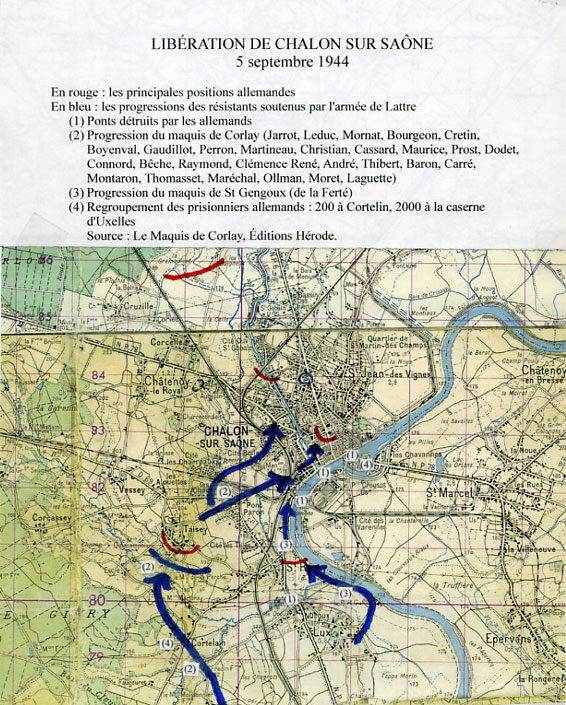
Having set out from Lyon along the right bank of the Saône, General du Vigier's 1st Armoured Division split into several independent units. Combat Command 1 (C.C.1) was led by General Sudre and advanced along a Villefranche–Chalon axis; C.C.2, under Colonel Kienst, followed the Cluny–Chagny road.
It was therefore the units of C.C.1 that were tasked with liberating Chalon. They were supported in this by a number of maquisards from Corlay, Saint-Gengoux and Cluny. Having spent the night in Sennecey, the French troops approached Chalon in the early morning. At 7.30 a.m. a first contact took place with enemy troops. The French were at first halted at Droux by the destruction of the bridge and by anti-tank gun and heavy machine-gun fire. In these conditions, the only option left was to attack Chalon from the west, that is, via Taisey.
The clashes were severe in the sector, around 8.30 a.m. The Château de Taisey nevertheless fell into French hands at 9.30 a.m. At 11.30 a.m. it was the turn of Châtenoy-le-Royal to be liberated. A squadron then made a move on Chalon via the Rue d'Autun, while other elements advanced gradually along the Givry road.
At the same time, with the support of Sherman tanks, a group of resisters advanced along the bank of the Saône, in the Californie district, after crossing the Orbize over the small Ma Campagne bridge that the Germans had forgotten to blow up.
Faced with the resistance shown by the Germans positioned in Chalon, the French had to bide their time. At 3 p.m., however, General Sudre gave the order to attack — via Châtenoy, the Rue d'Autun and the Avenue Boucicaut on one side, and via Taisey, the Givry road and the Grande Rue Saint-Cosme on the other.
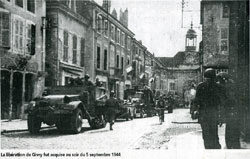
The advance was not the easiest, as the Germans kept defending to the last. That said, around 3.30 p.m. the Pont des Fainéants, over the canal, was taken. At Champ Fleury and on the Avenue Boucicaut, progress was no less marked, supported by several people of Chalon who gave information to de Lattre's soldiers and to the maquisards. The Germans still holding the Colombière bridge withdrew onto the boulevard. Everywhere the French advanced into Chalon. At 4 p.m. the maquisards seized the town hall.
Everywhere, as the bells of Chalon rang out at full peal, there was a frenzy of enthusiasm. Chalon was liberated.
After Gilles PLATRET.